Beware the Cyclops
The Danger of Monocular Vision in Mythology and Medicine
“All men, by nature, desire to know.”[1] So says Aristotle, in his Metaphysics. The philosopher goes on to directly connect our need for knowledge with the pleasure we take in our sight:
An indication of this is the delight we take in our senses; for even apart from their usefulness they are loved for themselves; and above all others the sense of sight. …We prefer seeing (one might say) to everything else. The reason is that this, most of all the senses, makes us know and brings to light many differences between things.[1:1]
We love our sight, and we desire knowledge. But knowledge is not free; like anything of value, it has a price. A strange and disturbing story of this price is found in the Prose Edda, a founding document of Norse mythology. It tells us that Odin, the All-Father and chief god, was aware of all the comings and goings of the earth through the reports of his twin messenger ravens, Huginn and Muninn. But he desired still more knowledge, and so he traveled to the base of Yggdrasil, the “world-tree,” in order to take a special drink:
‘Under the root that goes to the frost giants is the Well of Mimir. Wisdom and intelligence are hidden there, and Mimir is the name of the well’s owner. He is full of wisdom… All-Father [Odin] went there and asked for one drink from the well, but he did not get this until he gave one of his eyes as a pledge.[2]
One eye for one drink; it is a high cost. As a unit of payment, the eye is not subject to inflation. We only get two of them, whether born in the ancient Asgard or the modern west. But when one loses a metaphorical eye, what is it, exactly, that we have sacrificed?
In his 1927 book Poetic Diction, the British philosopher and poet Owen Barfield wrote about this story, saying “Our sophistication, like Odin’s, has cost us an eye.”[3] This was part of his thesis, developed in this book and in Saving the Appearances[4], that as mankind has evolved, we have made idols of the “appearances.” Here is what he means: in our everyday life, we fail to recognize that all that we see, feel, and interact with is not what is actually there – a physical world composed of tiny particles swirling about in mostly empty space – but rather, is a set of “appearances” that are created by the interaction of these “particles” with our sensory apparatus, which in turn are processed by our mind to generate the appearance of the world around us. Barfield writes that our ancient predecessors were aware that all of the “appearances” were generated, and therefore symbolic and full of meaning, but they believed that the generative force was external, i.e. related to the spirit world.
Barfield suggests that the modern world has lost the understanding that the appearances are generated, and has “evolved,” as a result of an increasing focus on science, to understand the appearances themselves as independent and real. Thus, we study mass, temperature, chemical reactions, etc., all parameters that can be observed and measured. He notes that through this process we have gained tremendous knowledge of the world - like Odin - but in return, have lost the sense of our creative role in the generation of the world as it appears. The world as experienced now is purely physical, and therefore devoid of meaning. Our sacrificed eye has bought us knowledge, but has made our world flat.
What does it mean, practically and in the arena of medicine, to say that our perceptual world has become flat? Abraham Verghese gives us an idea when he describes the “iPatient”:
The other way — call it the expedient way — is not formally taught, and yet residents seem to have learned it no matter where in the United States they trained. The patient is still at the center, but more as an icon for another entity clothed in binary garments: the “iPatient.” Often, emergency room personnel have already scanned, tested, and diagnosed, so that interns meet a fully formed iPatient long before seeing the real patient. The iPatient’s blood counts and emanations are tracked and trended like a Dow Jones Index, and pop-up flags remind caregivers to feed or bleed. iPatients are handily discussed (or “card-flipped”) in the bunker, while the real patients keep the beds warm and ensure that the folders bearing their names stay alive on the computer.[5]
Verghese points out that the problem with this approach is that “the map is not the territory.” The patient is more than a collection of findings encapsulated on a screen. This is another way of getting at Barfield’s point; we are attending to the “appearances,” rather than the underlying reality. The two authors even employ similar language; Barfield refers to making an “idol” of the appearances, while Verghese asserts that we have made the patient “an icon for another entity clothed in binary garments.” The term “icon” is particularly apt, since religious icons are typically two-dimensional painted representations; and while the term “binary” here refers to the computer code into which the patient has morphed, it also accounts for the number of dimensions in which the iPatient is perceived. Like blacksmiths, we have hammered our patients flat. As physicians, we can only treat what we can perceive, and as Verghese describes, we have very literally shifted our vision from three-dimensional (the patient) to two-dimensional (the computer’s flat screen).
Verghese proposes, in his article, to resist this tendency through a renewed emphasis on the physical examination of the actual human patient. This effort is essential. But I want to focus here on Barfield’s response, for I think that it has to come first.
In Barfield’s time (he died in 1997), he noted that we were just beginning to understand that the creative role of generating the world of appearance lies within our own minds. He proposed, therefore, that our sense of meaning in the world can be recaptured through the role of the imagination, which can help us to understand our role as co-creators of the world around us. His theory influenced his highly imaginative close friends and colleagues, the writers C.S. Lewis, Charles Williams, and J.R.R. Tolkien.
The practice of the medical humanities can help us to follow Barfield’s prescription. We must re-open our second eye, and re-learn to see the world in all available dimensions. Our patients must be more to us than what can be recorded on a screen, and the way to achieve this, as per Barfield, is through the constructive use of the imagination.
Every act of empathy is an act of imagination. Communication on a truly human level can only occur when “theory of mind” is exhibited; when one person imagines the interior life of another. Without this, our socialization is at the level of the animal. In order to see what communication looks like among those with monocular vision, we can look back again to the world of myth, this time focusing on ancient Greece. The story bears surprising concordances with Verghese’s concerns.
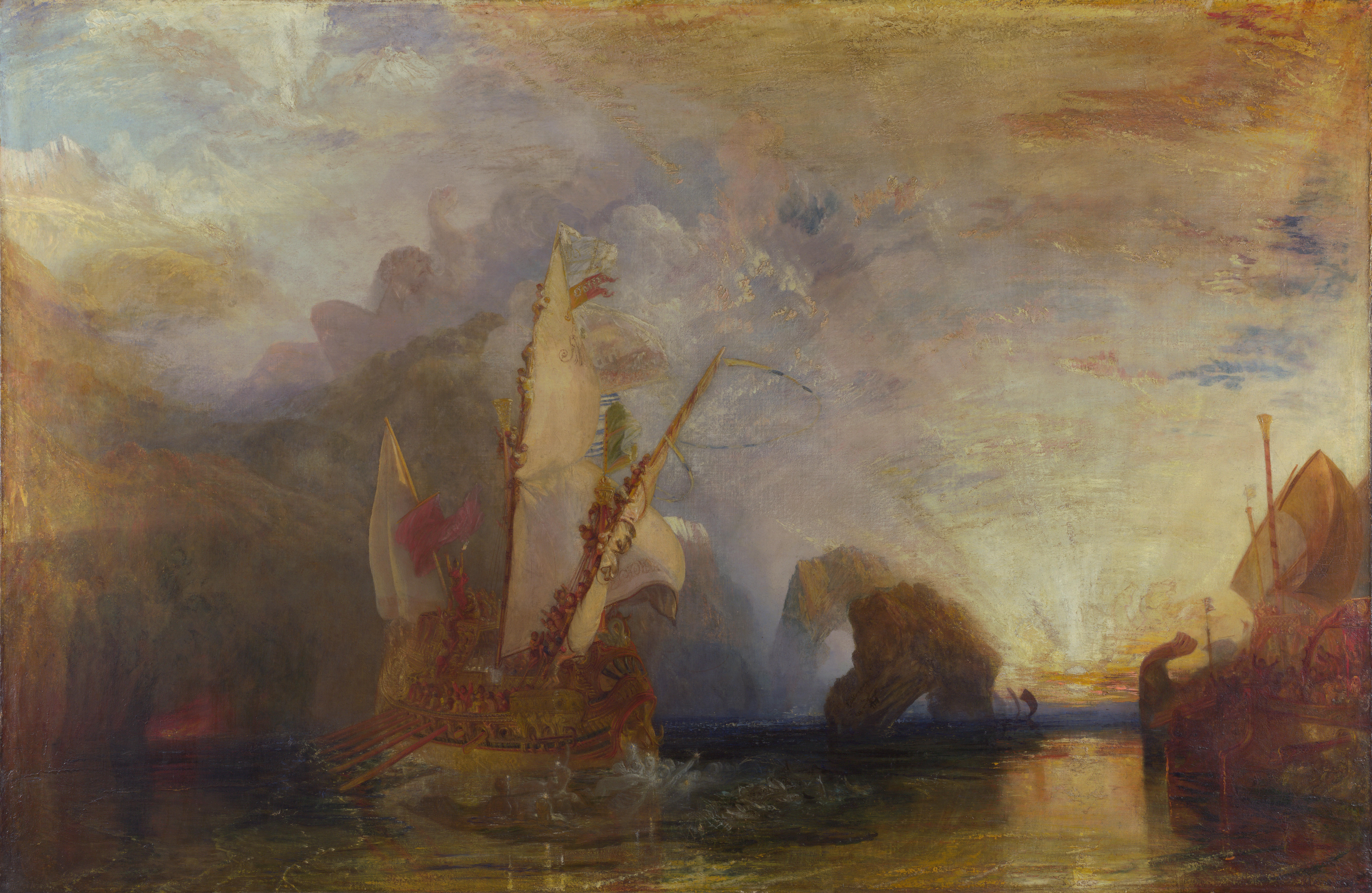
In Homer’s Odyssey, book IX, the cunning hero Odysseus finds himself in the cave of Polyphemus the cyclops, a monster with a single, central eye[6]. This cyclops lives alone in a great cave, where his material needs are all met through the maintenance of a large flock of sheep. He guards them – presumably from the other cyclopes that live on the island - with “deep fences,” and by the placement of an unimaginably large rock in the mouth of the cave:
“He heaved up and set into position the huge door stop, a massive thing; no twenty-two of the best four-wheeled wagons could have taken that weight off the ground and carried it, such a piece of sky-towering cliff that was he set over his gateway.”[7]
Polyphemus has mastered his small world through his skill and strength. His power is such, in fact, that he no longer fears the gods. When the cyclops discovers the Greeks in his cave, Odysseus hopefully asks him for a guest-present in honor of Zeus, the god of hospitality. Polyphemus replies:
“Stranger, you are a simple fool, or come from far off, when you tell me to avoid the wrath of the gods or fear them. The Cyclopes do not concern themselves over Zeus of the aegis, nor any of the rest of the blessed gods, since we are far better than they, and for fear of the hate of Zeus I would not spare you or your companions either, if the fancy took me otherwise.[8]
While boasting of his great power, Polyphemus exposes his great weakness. He can manipulate the physical world, but in his two-dimensional imagination, he cannot relate properly to other men. He does not see the Greek crew as fellow conscious beings with rich internal lives. Instead, they are mere objects to be manipulated, like the trees and stones that surround him. Rather than welcome them as guests, the Cyclops instead devours them, two at a time:
“So I spoke, but he in pitiless spirit answered nothing, but sprang up and reached for my companions, caught up two together and slapped them, like killing puppies, against the ground, and the brains ran all over the floor, soaking the ground. Then he cut them up limb by limb and got supper ready, and like a lion reared in the hills, without leaving anything, ate them, entrails, flesh and the marrowy bones alike.”[9]
Homer uses the phrase “pitiless spirit” three times to describe the cyclops. “Pity” is defined as “the feeling of sorrow or misfortune caused by the suffering of others,” and to be pitiless is to lack this fellow-feeling. The cyclops is incapable of imagining the interior lives of the Greeks, and so he is not only untroubled by their suffering; he is not even truly aware of it. What his single eye cannot see, does not exist for him; he cannot be concerned about that which he cannot conceive.
This lack of imagination leads to his downfall. Odysseus tells him that his name is “Nobody,” in the Lattimore translation[10]; others translate it “No-man.”[11] Polyphemus falls for the trick, because it makes perfect sense; to him, Odysseus is already “no man,” but an object to be manipulated. Each step in his downfall proceeds naturally from here. The Greeks, no different to him than his sheep, seem incapable of courage or ingenuity, so he fails to anticipate the burning log that they drive into his eye when he sleeps. As he staggers around blind, and calls for help, the two-dimensionality of all intra-cyclopes communication becomes evident; when he says “Nobody is killing me by force or treachery,” they inform him that if that’s the case, he must simply be sick, and therefore they can’t help him. Like Verghese’s residents doing rounds via computer in the workroom, the neighboring cyclopes don’t even approach the cave to have a look[12].
Odysseus and his men make their final escape by tying themselves to the underbellies of the sheep, and riding them out when Polyphemus moves the great stone. And here his 2-D perspective, deprived of its one great eye but which has taken over his entire perceptual apparatus, confounds him one last time. He fears the escape of the Greeks, so he examines the sheep as they leave:
Meanwhile their master, suffering and in bitter pain, felt over the backs of all his sheep, standing up as they were, but in his guilelessness did not notice how my men were fastened under the breasts of his fleecy sheep.[13]
Even when using his hands, the cyclops conducts a two-dimensional exam! He literally scratches only the surface of the sheep, and thereby misses the critical “diagnosis,” as the men lurk just beneath his superficial probe.
Polyphemus has tremendous power over the world, to be sure; flocks of sheep and goats, all the food he needs. He can move gigantic boulders with his limitless strength. His power has freed him from fear of the gods, but his monocular vision has blinded him to the natures of the men and animals that surround him. Because he cannot properly imagine their internal lives, he fails to recognize them for what they are – he eats the humans and speaks to the sheep. He knows no proper laws or customs, violates the laws of hospitality, and in the end, he is deprived of vengeance when he fails to differentiate between man and animal. Man, to him, is “no man,” but an object, an appearance.
The story of the cyclops, whose two-dimensional worldview results in disaster for himself and for his “guests,” provides a powerful metaphor in support of Verghese’s quest to counter the iconification of the patient through the use of the physical exam. But this defense will only work if it is preceded by a reintegration of the imagination. The physical examination is our acknowledgement of the patient’s three-dimensionality, not the creation of it. One would never attempt to dig a well into the surface of a bridge, because we know there’s nothing to find beneath. Before we dig, we must conceive of depths.
This is why the study of arts and literature is of critical importance among practitioners of medicine, and why its importance only grows, rather than fades, as our mastery of the appearances increases. The study of literature, and in particular literary fiction, has been shown to improve “theory of mind”[14]. This is a case of the data supporting a conclusion that should be obvious; great literature has captivated us for as long as we have possessed writing for this very reason. We take pleasure in imagining the interior life of others, and we learn from it, and recognize its importance instinctively. Through experiencing Hamlet, we briefly taste what it must be like to be another person; and in the imagining, we are, in a non-trivial way, co-creating that person. And this is true not only for the fictional, but for the actual. Certainly, each person that we meet has their own independent, objectively existing interior life; but we cannot see, touch, or hear it. Our only sense of it comes through the act of imaginative co-creation. I can hear Hamlet say “to be, or not to be…” but it is up to my imagination to probe the meaning and motivations that lurk beneath. The same is true when a patient says, “I’m not sure I can keep going.” We all co-create each other, with every genuine human interaction.
Mythology teaches us that our quest to control the world through increasing knowledge is connected to the flattening of our perception. This can, in turn, lead to a failure to appreciate the depths of our fellow humans’ internal lives. With this lost, we are tempted to approach people as objects that are subject to our manipulation. We see some of the monstrous potential of this change in the actions of Homer’s cyclops; but the danger has not been lost on modern mythologizers. Stanley Kubrick, in his masterful 1968 film 2001: A Space Odyssey, depicts the murder of a space crew by HAL 9000, an artificial intelligence agent whose physical manifestation takes the form of a single, glowing eye.
In the same film, Kubrick shows the destiny of mankind being manipulated by alien intelligences through the use of monoliths, large, flat, rectangular objects that startlingly resemble modern cell phones[15]. Even more recently, the unveiling of a new model of Apple iPad was heralded with the now-infamous commercial “Crush,” which depicted a massive hydraulic press crushing various implements of human creative endeavor, including musical instruments, brushes, paints and sculpting materials, a typewriter, and cameras, and compressing them all into a new iPad[16]. The specific point of the ad was to emphasize that the new iPad was so thin as to be almost two-dimensional. It would be a challenge to design a more precise metaphor to represent the inherently oppositional nature between human creative endeavor and the flatness of the 2D worldview.
Polyphemus and HAL-9000 show the extreme results of monocular vision. But even for Verghese’s well-meaning medical residents, their daily work has been reduced to manipulating data points on a screen. This is bad for the patients and the doctors. While it is good to normalize lab values, the goal of medicine is much greater: it is to care for a patient. The solution to this problem is to run the “Crush” commercial backwards. Open both eyes, and engage with human creative potential. Then our three-dimensional perception returns, and we can see both ourselves and our patients as co-creators of the world around us. This not only improves our understanding of others, but it restores our sense that the world, and our work, has meaning.
Aristotle. Metaphysics. Translated by W. D. Ross. CreateSpace Independent Publishing Platform, 2016. Book I. ↩︎ ↩︎
Snorri Sturluson. The Prose Edda. Translated by Jean I. Young. University of California Press, 1954, p. 58. ↩︎
Owen Barfield. Poetic Diction. Wesleyan University Press, 1984. ↩︎
Owen Barfield. Saving the Appearances. Faber & Faber, 1957. ↩︎
Abraham Verghese. “Culture Shock: Patient as Icon, Icon as Patient.” New England Journal of Medicine 359 (26). ↩︎
Homer. The Odyssey of Homer. Translated by Richmond Lattimore. (1975) 2007. Book IX. ↩︎
Homer. The Odyssey of Homer. Translated by Richmond Lattimore. (1975) 2007, p. 143. ↩︎
Homer. The Odyssey of Homer. Translated by Richmond Lattimore. (1975) 2007, p. 144. ↩︎
Homer. The Odyssey of Homer. Translated by Richmond Lattimore. (1975) 2007, pp. 144–145. ↩︎
Homer. The Odyssey of Homer. Translated by Richmond Lattimore. (1975) 2007, p. 146. ↩︎
Homer. Odyssey. Translated by Stanley Lombardo. Indianapolis: Hackett Publishing Company, 2000, pp. 135–136. ↩︎
Homer. The Odyssey of Homer. Translated by Richmond Lattimore. (1975) 2007, pp. 147–148. ↩︎
Homer. The Odyssey of Homer. Translated by Richmond Lattimore. (1975) 2007, p. 148. ↩︎
David Comer Kidd and Emanuele Castano. “Reading Literary Fiction Improves Theory of Mind.” Science 342 (6156) (2013): 377–80. ↩︎
Stanley Kubrick. 2001: A Space Odyssey. 1968. ↩︎
Vania Heymann and Gal Muggia. Crush. Edited by Iconoclast. Apple, 2024. ↩︎
Brian Quaranta, MD, MA
Dr. Brian Quaranta is Associate Professor of Radiation Oncology at Duke University. In addition to his medical interests, he is interested in literature, history, psychology, and philosophy, and has an MA in Shakespeare and Theatre from the Shakespeare Institute at Stratford-upon-Avon. He has also graduated from the Theology, Medicine, and Culture program at Duke Divinity School. Recent courses taught include Narrative Medicine for Medical Learners, and Plague Literature: Ancient and Modern. Research projects include looking at issues of medical ethics as portrayed in Shakespeare’s plays; mimetic theory in Shakespeare and in medical practice; and other projects involving the intersection of literature, film, and medicine.