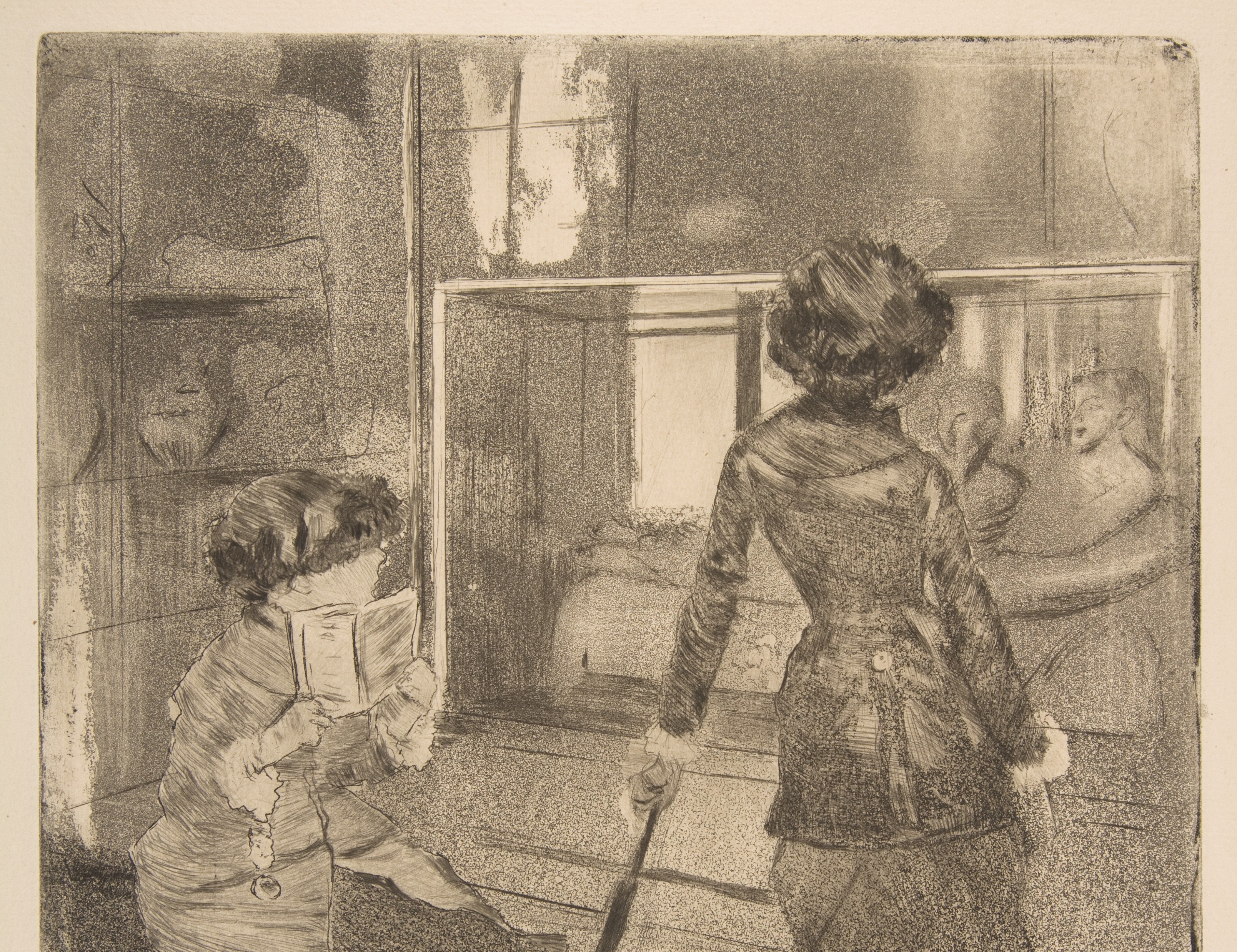
The Power of Art to Prompt Reflection
The Personal Responses Tour (PRT) as a Tool for Professional Identity Formation in Health Professions Education
Johns Hopkins University School of Medicine
How do you open a teaching session about hope, compassion, healing, or suffering in medicine in a way that truly invites learners into a space of reflection and meaningful discussion? Across health professions education, sessions devoted to professional identity formation, the process by which learners come to think, act, and feel like members of their profession, may follow a familiar didactic format: a definition, a case, a discussion, and a list of practical takeaways for clinical practice.[1] It works, but something is often missing. The conversation stays at the level of the head, rarely integrating the heart or the hands. Learners engage with the concepts at stake intellectually rather than as something they’ve experienced firsthand.
A Personal Responses Tour (PRT) of a curated gallery of images, in the form of physical cards or digital images, offers a different way to open such sessions.[2] After the group has gathered, the facilitator reads a prompt, which asks each participant to select from the gallery of images one image that connects to the specific concept that will be the focus of the session. For instance, if the focus of the session is hope in medicine, the prompt is: “Find an image that connects to the concept of hope for you.” Each participant then looks through the gallery of images, selects one that – for them – connects to the prompt, and takes a moment to reflect on the connection. After everyone has selected an image, they will each – in turn – then share their selection with the group. In ten minutes, the group has learned something about each person and developed a collective view of the concept being discussed, setting the stage for the more analytic discussion to follow. By engaging everyone in this initial period of personal reflection and sharing, the PRT can build the kind of trust that enriches the group discussion to follow.
What is a PRT?
The PRT is a guided, visual arts-based learning activity in which participants are given a prompt and invited to find a work of art (e.g., painting, photograph, or other image) that – for them – resonates with that prompt. Participants then share their chosen work and the connection it sparked with the larger group. No knowledge of art or art history is required to lead or participate in a PRT.
The PRT draws on the concept that educator Parker Palmer calls a “third thing”: an object external to both the participant and the facilitator that serves as a reflective trigger or conversational mediator to help create a safe space for making meaning and sharing perspectives.[3] The artwork invites a conversation and helps participants approach difficult questions at an angle, creating what Palmer - borrowing from Emily Dickinson - calls “tell all the truth but tell it slant.” Because a participant can always return to talking about what they see in the image if their reflection becomes too personal, the art serves a quietly protective function.
For educators concerned with professional identity formation, the PRT is particularly well suited to exploring the values, virtues, ethics, and moral dimensions of the health professions in ways that are experiential and invitational. It adapts readily to nearly any setting in which clinicians or trainees gather to reflect on core dimensions of their work, whether it be a small-group didactic, an interprofessional seminar, a residency retreat, an ethics discussion, or a faculty development workshop.
How to Facilitate a PRT
The PRT does not require a museum, a budget, or extensive preparation. Here are three formats you can adapt immediately:
The Classroom PRT: Curate a set of images (e.g., laminated art cards,[4] art museum postcards, or printed photographs). Spread them on a table(s) in the room. Give the group a single prompt such as: “Choose an image that connects to what being a physician means to you,” or “Find an image that represents the virtue of courage for you.” Allow two to three minutes for silent selection and reflection then invite participants to share the image they selected and the connection with the full group.
The Museum PRT: If your program has access to an art museum, a museum-based PRT format can be implemented. This format is ideal for building community among learners, for bringing together participants across cohorts, programs, or professions, and for introducing arts-based reflection to the wider campus community. Before the visit, you can either decide on one prompt for all participants (as above) or prepare cards with unique, individual prompts, either from a deck of virtues or of your own design.[5] If using a shared prompt, this can be spoken by the facilitator. If using an individual prompt, each participant draws one at random from a deck or basket. Allow 5-10 minutes for each participant to explore a pre-selected set of art galleries to find an artwork that connects with the prompt. Participants then reconvene and tour the galleries together, pausing at each person’s chosen work while they share their prompt (if it is an individual rather than shared one) and how the artwork they selected connects to the prompt. For a group of 12-15 people, 45 minutes is sufficient for the whole activity.
The Digital PRT: For online meetings or larger groups, curate a digital gallery of images using either a PPT slide deck or an online tool like Padlet.[6] Post a prompt and invite participants to select an image from the digital gallery and briefly reflect on why it resonates.[7] The anonymity of reflecting in writing on a digital platform like Padlet can lower inhibition and surface candid responses.
For all three formats, we recommend a debrief after the experience, asking participants to reflect on the process, what the PRT asked of them, and, if appropriate, how the work of art affected how they responded to the prompt.
What Makes It Work
A few facilitation principles are noteworthy.
Design your prompts with intention to align with learning objectives and stimulate personal reflection. Your prompts may connect to specific values or core dimensions of professional identity. Or, depending on your objectives, you may choose other prompts such as “Find an image that connects to your motivation to pursue your profession” or “Find an image that represents a patient experience you carry with you.”
Keep the ratio small. A learner-to-facilitator ratio of fifteen to one (15:1) or fewer supports psychological safety upon which the activity depends. In larger groups, you may use small breakout groups before reconvening.
Facilitators should participate too. However, do not go first! Let the group establish its own tone before sharing yourself. Modeling vulnerability is part of the facilitator’s role. Facilitators may do that by going slightly deeper than you might expect others to go on their own.
Paraphrase and link. After participants share, briefly paraphrase what you heard to demonstrate genuine listening. You may weave individual responses into an overall picture and name connections between different participants’ responses. These connections help build the community.
What we have seen, across informal gatherings and formal educational settings alike, is that the PRT consistently surprises people. Participants may arrive skeptical about an “art activity” and later find themselves realizing they learned something new about themselves and their colleagues. By fostering personal reflection and building community, the PRT allows the discussions that follow to go more deeply more quickly. More importantly, the PRT serves a formative function in professional identity formation by cultivating clinically relevant capacities such as attentiveness, humility, openness to other perspectives, and tolerance for ambiguity, all of which enable us to take better care of the patients we serve.
Richard L. Cruess et al., “Reframing Medical Education to Support Professional Identity Formation,” Academic Medicine 89, no. 11 (2014): 1446–51. ↩︎
Elizabeth Gaufberg and Ray Williams, “Reflection in a Museum Setting: The Personal Responses Tour,” Journal of Graduate Medical Education 3, no. 4 (2011): 546–49. ↩︎
Elizabeth Gaufberg, Molly Ward Olmsted, and Sigall K. Bell, “Third Things as Inspiration and Artifact: A Multi-Stakeholder Qualitative Approach to Understand Patient and Family Emotions after Harmful Events,” Journal of Medical Humanities 40, no. 4 (2019): 489–504. ↩︎
“Visual Explorer,” HRDQ, accessed August 5, 2026, https://hrdqstore.com/products/visual-explorer. ↩︎
Gaufberg and Williams, “Reflection in a Museum Setting.” ↩︎
Padlet, accessed August 5, 2026, https://padlet.com/. ↩︎
Margot Kelly-Hedrick et al., “The Online ‘Personal Responses Tour’: Adapting an Art Museum–Based Activity for a Virtual Setting,” Academic Psychiatry 46, no. 4 (2022): 510–14. ↩︎
Khalid Elzamzamy, MD MA
Dr. Khalid Elzamzamy is an Assistant Professor of Psychiatry and Behavioral Sciences, Johns Hopkins University School of Medicine.
Maria Morcos
Maria Morcos is a medical student and the Hippocratic Society Chapter Leader at Johns Hopkins University School of Medicine
Margaret S. Chisolm, MD
Dr. Margaret Chisolm is a Professor of Psychiatry and Behavioral Sciences at Johns Hopkins University School of Medicine.